
Timber vs Steel Framing: Which Is Right for Your Build?
An honest comparison of timber and steel wall framing for Newcastle and Hunter homes, covering cost, termites, thermal performance and buildability.
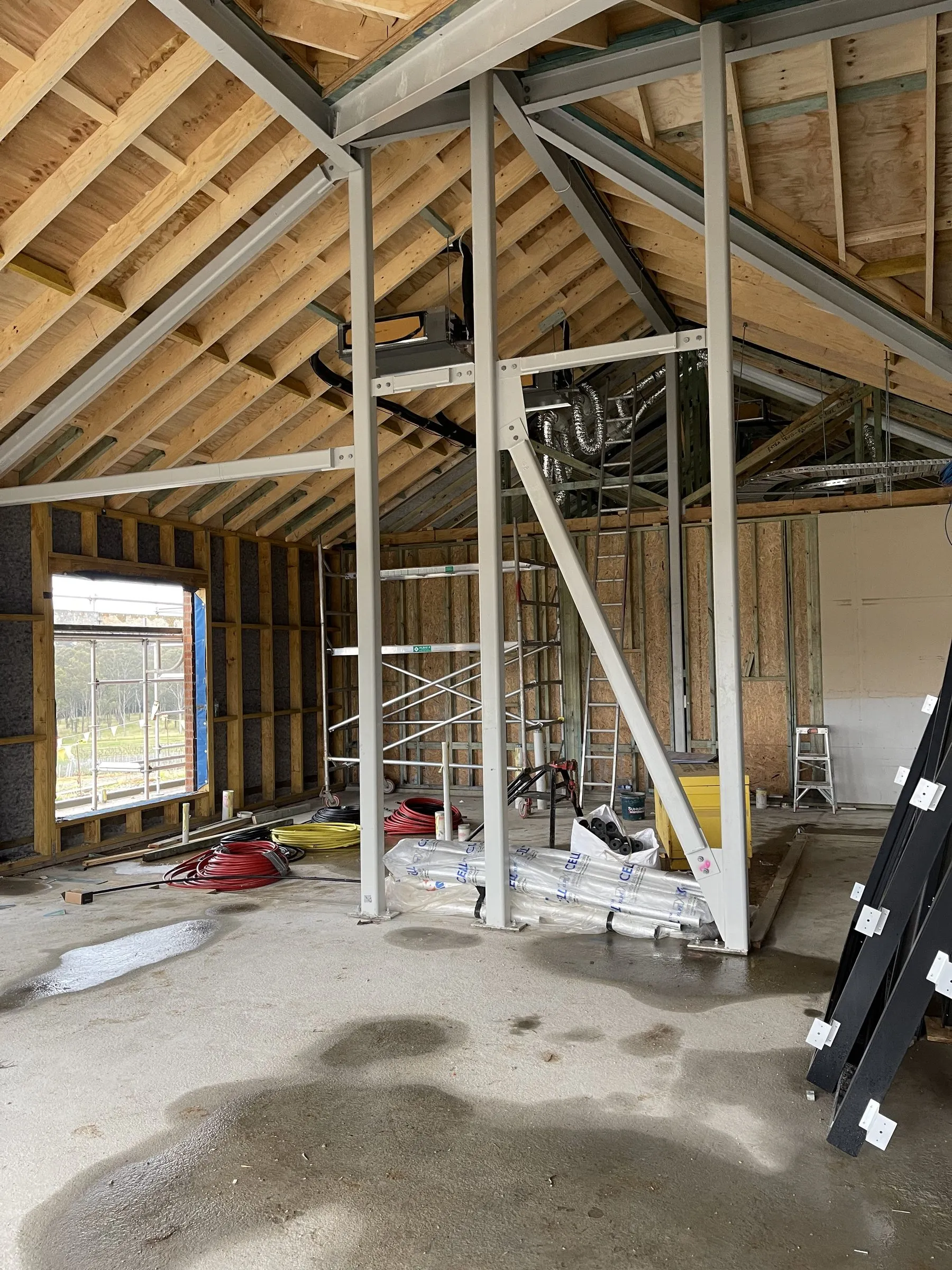
Both work. Both are used across the Hunter every day. The right answer depends on your site, your budget and what you care about.
Cost
Timber is typically 5 to 15% cheaper to frame than steel for a standard house, though the gap moves with timber pricing, which has been volatile in recent years.
Steel is more consistent in price because it is an industrial product with stable supply.
Verdict: timber usually wins, but not by as much as people assume.
Termites
This is the strongest argument for steel, and around the Hunter it is a real one. Termite pressure here is significant.
Steel is immune. Timber requires a termite management system: a physical barrier, a chemical barrier, or naturally resistant or treated timber, plus ongoing inspection.
That said, a steel-framed house still contains timber in the roof battens, joinery, skirtings and door frames, so termite management is not eliminated entirely.
Verdict: steel wins clearly.
Thermal performance
Steel conducts heat roughly 400 times better than timber. Every steel stud is a thermal bridge, a path for heat to move through the wall regardless of the insulation between the studs.
This is managed with thermal break strips over the studs, which are required by the code. Done properly it is fine. Done poorly, a steel-framed house is noticeably harder to keep comfortable.
Timber is a natural insulator and has no bridging problem.
Verdict: timber wins, unless the steel frame is detailed properly with thermal breaks.
Straightness and stability
Steel does not warp, shrink, twist or split. It comes precisely to length and it stays that way.
Timber moves as it dries. A frame built with high moisture content timber will shrink, and that shows up as nail pops in plasterboard, cracked cornice and sticking doors in the first couple of years.
Good timber, properly stored and reasonably dry, minimises this. Wet timber straight off a truck in winter does not.
Verdict: steel wins.
Buildability and changes
Timber can be cut, packed and adjusted on site with tools every carpenter carries. If a design changes or something is out by 20mm, it is resolved in minutes.
Steel is usually prefabricated to a shop drawing. Changes on site are slower, require specific tools and connections, and sometimes require going back to the fabricator.
Verdict: timber wins, particularly on renovation work where the existing house is never quite what the plans say.
Fire and bushfire
Steel does not burn, which helps in bushfire-prone areas, though it loses strength at high temperatures.
Timber chars, and there are compliant timber solutions for most bushfire attack levels.
Verdict: steel has an edge at higher BAL ratings.
Sound
Steel frames transmit slightly more impact sound and can be prone to a tinny quality if not properly detailed with resilient mounts on party walls.
Verdict: timber has a small edge.
Environmental
Timber from certified sources is renewable and stores carbon. Steel is highly recyclable and Australian steel usually has good recycled content.
Both have reasonable cases. Timber generally has lower embodied energy.
What we recommend
Renovations and extensions on existing homes: timber, almost always. Existing houses are never square or level, and timber lets us adapt on site. This is most of our work.
New builds in high termite pressure areas: steel is worth serious consideration.
Where budget is the primary driver: timber.
Where long straight walls and a very flat finish matter: steel.
Bushfire areas at higher BAL: steel, or timber with the appropriate compliant detailing.
Whichever you choose, the frame has to be square, plumb and set out accurately. A badly built steel frame is worse than a well-built timber one, and we have straightened plenty of both.
We frame in timber and steel across Newcastle, Lake Macquarie and the Hunter.
More building advice
Insulation That Actually Works in Newcastle Homes
Where insulation matters most in the Hunter climate, why installation quality beats R-value, and what to do during a renovation while walls are open.
Roof Trusses or Conventional Framing? What Suits Your Roof
The trade-offs between prefabricated roof trusses and conventional stick framing, including cost, roof space, cathedral ceilings and renovation work.
Structural Steel in Home Renovations: When and Why
When a renovation needs structural steel rather than timber, how beams are sized and supported, and what it costs to open up a Newcastle home.